
Stone, Tile & Grout · August 24, 2026
Is Your Grout Beyond Cleaning? How to Tell If It Can Be Restored
Dark grout is usually holding soil, not stained for good. How to tell what will clean up, what needs sealing, and what genuinely needs replacing.
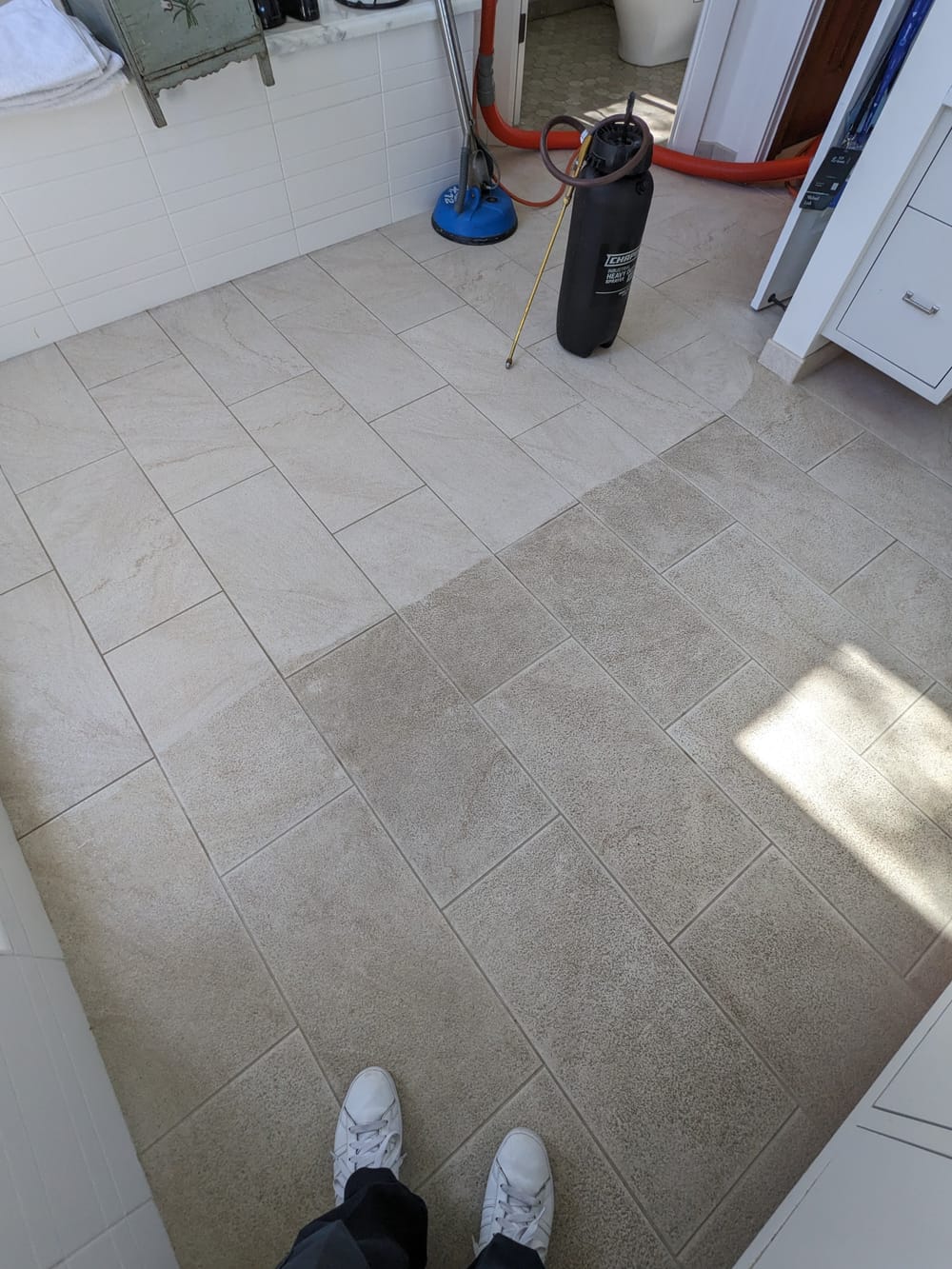
Almost every tile job we quote starts with the same sentence, in some form: I think the grout is just stained now. Sometimes that is true. Far more often, the grout is fine and it is full of something.
Here is how we tell the difference, and how you can make a decent guess before anyone comes out.
What dark grout usually is
Grout is porous. It is a cementitious material full of tiny voids, and it sits a few millimeters below the surface of the tile around it. That geometry is the whole problem: every time a mop crosses the floor, it rides on the tile and pushes dirty water down into the joint. The water evaporates. The soil stays.
Do that weekly for three years and you get a floor where the tile looks acceptable and the grid between it looks grey, brown, or black. Nothing has been dyed. The grout is holding years of soil in its pores, and the mop keeps adding to it.
That is why the first thing we do is not scrub harder. Truck-mounted hot water extraction flushes the joint with hot solution and pulls it, and the soil in it, out of the house entirely. On a floor that has never been professionally cleaned, coming back several shades is a normal result, not an exceptional one.
The three things that actually mean trouble
Cleaning does not fix everything. These are the cases where we will tell you so at the estimate rather than after you have paid for a cleaning:
The grout is physically failing. Cracked, crumbling, or missing grout is a repair job, not a cleaning job. Extraction on failing grout can make gaps more obvious, which is worth knowing in advance.
The grout was dyed or color-sealed. Color sealing puts a pigmented coating over the grout. When that coating wears unevenly it looks blotchy, and cleaning will not even it out — the coating has to be dealt with on its own terms.
The stain is in the material, not the pores. Some things genuinely stain: certain dyes, rust bleeding through from below, long-term oil in an unsealed floor. These are less common than people think, but they exist.
Everything else — grey, dull, uneven, “it just always looks dirty” — is a soil problem, and soil problems clean up. In central and north Marin, a chalky or grey band at the tile edges is often hard water mineral film rather than soil, and it cleans up too, with the right product.
A quick test you can do yourself
Wet a small, inconspicuous section of grout with plain water and let it sit for a minute. Then look at it while it is wet.
- If the wet grout looks noticeably lighter and more even than the dry grout around it, you are looking at surface soil and a worn or missing sealer. That floor will clean up.
- If the wet grout looks essentially the same shade as dry, the discoloration is deeper in the material, and you should expect improvement rather than transformation.
This is not a laboratory test, but it is a useful one, and it costs nothing.
Why sealing is the second half of the job
Cleaning grout without sealing it is like washing a sponge and putting it back under the sink. The pores are now open and clean, and the next twelve months of foot traffic go straight back into them.
A sealer keeps the soil sitting on top, where a broom and a neutral-pH cleaner can reach it. It is the difference between a floor that looks good for three years and a floor that looks tired again by spring. If you are not sure whether your grout was ever sealed, the water-drop test will tell you in five minutes. Most stone, all grout lines, and many clay and cementitious materials are porous enough to need it, and we apply it while the surface is clean and dry — right after cleaning, which is the only time it will ever be in that state.
In Marin, sealer life depends heavily on where you live. Coastal salt air and marine damp in Sausalito are harder on sealers than a dry inland house. Shaded canyon homes in Mill Valley deal with organic film on slate and Saltillo. Tiburon and Belvedere tend toward marble and limestone, where the question is often etching rather than staining at all.
What to do next
If your grout is dark and your tile is intact, the odds are strongly in your favor. Send us a photo by text — the fastest way to get a real answer is a picture of the actual floor — or ask for a free estimate. We will tell you what is achievable before you spend anything, including the times when the honest answer is that cleaning will not get you where you want to be.
More on the process, the surfaces we handle, and how sealing works is on our stone, tile and grout page, and the questions we get asked most are collected on our FAQ page.
Frequently asked
Can dark grout be cleaned, or does it have to be replaced?
In most homes it can be cleaned. Grout that looks permanently dark is usually holding soil in its pores rather than being dyed through, and hot water extraction typically brings it back several shades. Replacement is a last resort for grout that is cracked, crumbling, or worn below the surface.
Is grout a porous surface?
Yes. Cement-based grout is full of microscopic voids, which is why it absorbs mopping water, soil, and mineral deposits and why it darkens over time. Epoxy grout is the exception: it is essentially non-porous, rarely discolors, and is uncommon in older Marin homes. Sealing cement grout is what keeps the pores from filling back up after a cleaning.
How do you clean grout in floor tiles?
At home: a neutral-pH tile cleaner, a soft grout brush, and clean rinse water changed often, so you are not mopping soil back into the joints. Professionally: hot water extraction, which flushes each joint with hot solution and vacuums it out of the house rather than leaving it in the low point. Skip bleach and acidic products; they strip sealer and damage natural stone.
Do you repair or replace grout?
Cracked, crumbling, or missing grout is tile-setter work rather than cleaning work, and we will tell you so at the estimate instead of after you have paid for a cleaning. Where the grout is intact but dark, cleaning and sealing is the right job, and it is ours.
Why does my grout look dirty right after I mop?
Because a mop head rides on top of the tile while the grout joint sits below it. Mopping pushes dirty water into the low point and leaves it there. Extraction flushes the joint and removes the water instead of redistributing it.
Related reading
Stone, Tile & Grout
Faded Saltillo Tile: Cleaning and Resealing to Bring the Color Back
Faded, blotchy Saltillo has usually lost its sealer, not its color. Why it happens, how to clean Saltillo tile safely, and how resealing brings the tone back.
Read the postStone, Tile & Grout
What Salt Air Does to Floors in Sausalito
Salt grit, fog, and marine damp wear Sausalito floors faster than inland ones. What happens to stone, grout, carpet, and hardwood, and how to slow it down.
Read the postStone, Tile & Grout
Slate Floor Cleaning: Bringing Back a Dull Slate Entry in Mill Valley
Why slate entries and steps go dull in shaded Mill Valley canyons, what mopping cannot reach, and how cleaning and resealing bring the color back.
Read the postReady for a cleaner home?
Call or text us for a free, no-pressure estimate. We’ll give you an honest assessment of what your space needs, and what it doesn’t, at an upfront price, with no surprises.