
Stone, Tile & Grout · September 8, 2026
Natural Stone Care in Marin: Marble, Travertine, Limestone, Slate and Granite
Marble, travertine, limestone, slate, and granite each behave differently under spills, cleaners, and foot traffic. What each one needs, what damages it, and how to tell etching from staining.
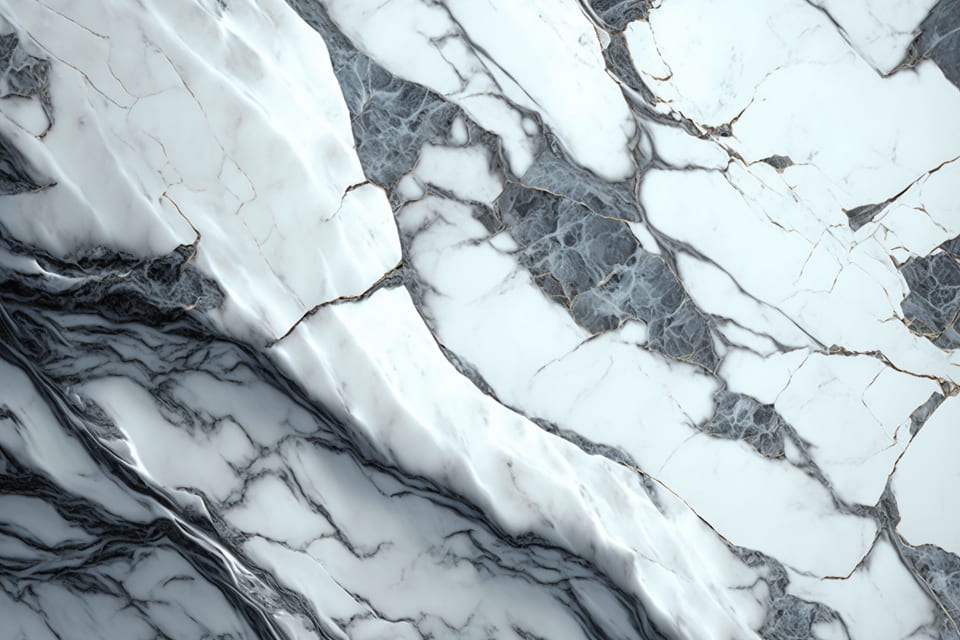
“Natural stone” is not one material. The five we see most in Marin homes — marble, travertine, limestone, slate, and granite — react to spills, cleaners, and foot traffic in genuinely different ways, and the care that protects one can damage another.
If you only read one section, read the one on etching versus staining. It is the distinction that decides whether a mark on your stone is a cleaning problem or a restoration problem, and getting it wrong is how people spend money on the wrong fix.
Travertine
Travertine is a form of limestone full of natural voids. Many floors are filled and honed at the factory, and over time those fills pop out, leaving pits that collect soil.
- Its weakness: it is calcite-based, so anything acidic — citrus, wine, vinegar, many bathroom cleaners — etches it on contact.
- What it needs: neutral-pH cleaning, prompt spill wiping, and a sealer that keeps soil out of the open pores.
- What we do: flush the pores with hot water extraction, address failed fills where appropriate, then reseal.
Marble
Marble is the most beautiful and least forgiving stone in the house, and in Marin it is most often a kitchen counter or an entry.
- Its weakness: the same acid sensitivity as travertine, but on a polished surface where every dull spot is visible. A single glass of wine left overnight leaves a mark.
- What it needs: coasters, prompt wiping, and a strict ban on general-purpose cleaners.
- What we do: restore etched surfaces back to a uniform finish, then seal. Most of our Tiburon and Belvedere stone work is exactly this.
Limestone
Limestone is travertine’s denser cousin, and in Marin it shows up as honed floor tile, fireplace surrounds, and the occasional exterior entry. It shares travertine’s chemistry without the open pits.
- Its weakness: calcite-based, so it etches on contact with acid, and because it is usually honed rather than polished, etching reads as a slightly darker, rougher patch rather than a dull spot. It also takes oil and dark liquids into the pores readily.
- What it needs: sealing on a schedule, neutral-pH cleaning, and mats at entries to keep grit from scratching the honed surface.
- What we do: hot water extraction to flush the pores, restoration of etched or scratched areas where the finish allows it, then a penetrating sealer.
Slate
Slate is the outlier: it is not calcite-based, so it does not etch. It has its own problems.
- Its weakness: it flakes and spalls in layers, and in shaded, damp Marin locations it grows an organic film that dulls the surface.
- What it needs: regular removal of that film, and an enhancing or penetrating sealer depending on the look you want.
- What we do: clean out the surface, then seal — and discuss enhancing sealers if you want the wet-look color depth back.
Granite
Granite is the forgiving one. It is not calcite-based, so it does not etch, and it is hard enough to shrug off most of what a kitchen throws at it. That is why it is on so many Marin counters.
- Its weakness: it is still porous. Cooking oil, wine, and coffee left to sit will darken it, and the darker the granite, the longer the stain hides before you notice it. The other failure is a worn sealer that leaves a cloudy, blotchy look around the sink and stove.
- What it needs: a working sealer, checked with the water-drop test once or twice a year, and prompt wiping of oils.
- What we do: clean the pores out, draw out oil stains where they are recent enough to move, and reseal.
Etching versus staining, the one distinction worth learning
If a mark is lighter and duller than the stone around it, it is etching. An acid reacted with the surface and changed its finish. No cleaner will fix it; the finish has to be mechanically restored.
If a mark is darker than the stone around it, it is a stain. Something soaked into the pores and needs to be drawn back out.
People spend a lot of money on the wrong product because these look similar in kitchen lighting. Photograph it in daylight, and if you are unsure, send us the photo.
On calcite stone, both problems are common and both are fixable. Etching is restored by re-honing or re-polishing the surface back to a uniform finish. A stain is drawn out of the pores with a poultice or extraction, depending on what caused it. The one thing neither responds to is scrubbing harder with a stronger product, which is how a small etch becomes a large one.
The care routine that works for all three
- A neutral-pH cleaner formulated for stone. Nothing else.
- Wipe spills promptly, especially oils, wine, and citrus.
- Mats at entries to trap grit before it reaches the stone.
- Professional cleaning and resealing every two to three years, and toward the shorter end in coastal and damp locations. If you are not sure whether your sealer is still working, the water-drop test takes five minutes.
More detail on the surfaces we handle and how sealing works is on our stone, tile and grout page, or ask us for a free estimate.
Frequently asked
What is the difference between etching and staining on marble?
Etching is dull and lighter than the surrounding stone: an acid has reacted with the surface and changed its finish. A stain is darker than the surrounding stone and sits in the pores. Etching needs a mechanical restoration; a stain needs drawing out. They are different jobs.
Can etched marble be repaired?
Yes, in most cases. Etching is a change to the surface finish rather than something in the stone, so it is corrected mechanically by re-honing or re-polishing the affected area back to a uniform finish, then sealing. Deep etching from a spill left for days takes more work than a ring from a glass, but both are restoration jobs, not cleaning jobs.
Does granite need to be sealed?
Most granite does, though less often than marble or limestone. Granite is dense and does not etch, but it is still porous enough to take oil and dark liquids into the pores. The water-drop test tells you where you stand: if water darkens the stone within a few minutes, it is time to clean and reseal.
What is the best cleaner for marble floors?
A neutral-pH cleaner formulated for stone, diluted as directed, applied with a clean mop or microfiber. Nothing acidic, nothing with bleach or ammonia, and no general-purpose sprays. The product matters less than what you keep away from the floor.
Is vinegar safe on natural stone?
No. Vinegar is acidic and will etch marble, limestone, and travertine. Use a neutral-pH cleaner made for stone, and keep vinegar, bleach, ammonia, and general-purpose sprays away from it entirely.
Related reading
Stone, Tile & Grout
Grout Sealing: What It Does and How Long It Lasts in Marin
A grout sealer slows absorption. It does not waterproof a shower or fix cracked grout. How long it lasts in Marin, and how to tell when yours has worn off.
Read the postStone, Tile & Grout
Sealed vs. Unsealed Stone: What Every Marin Homeowner Should Know
What a stone sealer actually does, what it cannot do, how to test whether yours is still working, and how long it should last in a Marin home.
Read the postStone, Tile & Grout
Is Your Grout Beyond Cleaning? How to Tell If It Can Be Restored
Dark grout is usually holding soil, not stained for good. How to tell what will clean up, what needs sealing, and what genuinely needs replacing.
Read the postReady for a cleaner home?
Call or text us for a free, no-pressure estimate. We’ll give you an honest assessment of what your space needs, and what it doesn’t, at an upfront price, with no surprises.